K.D. Medical College Hospital & Research Center, Mathura- Amrita Hospital, Faridabad
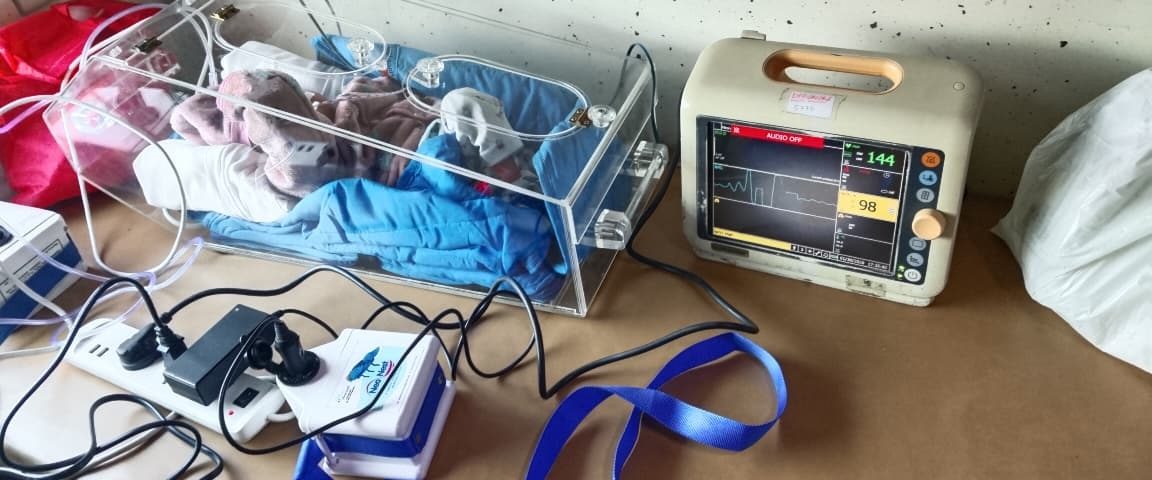
Road Ambulance for Twin Newborns on CPAP Support
A NICU Road Ambulance transfer was coordinated from Mathura to Faridabad for two four-day-old, very-low-birth-weight newborns weighing approximately 1 kg and 1.2 kg. Both babies required continuous CPAP respiratory support, thermal protection and close monitoring throughout the road journey.
Two High-Risk Newborns Requiring Transfer Together
Transporting a newborn requires significantly different planning from routine adult patient transfer. In this case, the complexity was increased because two four-day-old babies needed to be shifted together from Mathura to Amrita Hospital, Faridabad.
One baby weighed approximately 1 kg, while the other weighed around 1.2 kg. At these weights, newborns have limited physiological reserves and can be particularly vulnerable to changes in body temperature, oxygenation and respiratory effort during movement.
Both babies were receiving continuous positive airway pressure, or CPAP, and needed uninterrupted respiratory assistance during transportation. The objective was therefore not simply to move the twins between two cities, but to maintain NICU-level continuity throughout the journey.
Why Low-Weight Neonatal Transport Requires Special Planning
Very-low-birth-weight neonates can deteriorate rapidly if respiratory support, temperature control or monitoring is interrupted.
Even relatively short periods outside a controlled neonatal environment may expose a small baby to risks such as:
- hypothermia
- increased work of breathing
- oxygen desaturation
- displacement of the CPAP interface
- apnoea or respiratory deterioration
- changes in heart rate
- instability during handling and movement
These concerns become even more important when two babies requiring respiratory support are being transferred simultaneously.
A neonatal ambulance service therefore needs to account for respiratory equipment, adequate oxygen supply, thermal protection, monitoring equipment, trained medical personnel and contingency planning before movement begins.
One Transport Incubator with Separate CPAP Support
Both newborns were transported together within a transport incubator so that a controlled thermal environment could be maintained during the road journey.
Although the babies travelled within the same incubator environment, their respiratory support remained separate.
Each baby required an independently maintained CPAP setup appropriate to their individual respiratory needs. This allowed the clinical team to observe and manage each neonate separately rather than treating the twins as a single monitoring unit.
Maintaining the CPAP interface was particularly important. During ambulance movement, vibration, repositioning or handling can potentially affect mask or nasal-prong positioning and alter the effectiveness of non-invasive ventilatory support.
The medical team therefore had to continuously ensure that respiratory assistance remained appropriately delivered to each baby throughout transportation.
Critical Care Team During the Mathura to Faridabad Journey
A critical care doctor accompanied the twins during the transfer along with two trained nurses, providing additional support for simultaneous observation of both newborns.
This was particularly relevant because each baby had separate respiratory requirements.
During neonatal transport, the clinical team needs to repeatedly assess parameters such as:
- oxygen saturation
- heart rate
- respiratory pattern
- effectiveness of CPAP support
- airway position
- body temperature
- overall clinical responsiveness
Rather than relying only on monitor readings, direct clinical observation remains important in newborn transport because subtle changes in respiratory effort, colour or activity may provide an early indication of deterioration.
Maintaining Respiratory and Thermal Stability on the Road
The Mathura-to-Faridabad journey required continuous critical care transport rather than conventional ambulance movement.
The incubator helped reduce exposure to environmental temperature changes, while respiratory support was continued throughout the journey.
For babies weighing approximately 1 kg and 1.2 kg, limiting unnecessary handling was also important.
Movement was kept controlled while the medical team maintained access to both babies and their respective CPAP systems.
Oxygen availability had to be planned for the complete transfer rather than only the expected driving time. Medical transport planning also needs to consider possible road delays, loading and unloading, hospital handover time and unexpected changes in respiratory requirements.
This is particularly important when two neonates are simultaneously dependent on oxygen-driven respiratory support.
Road Transfer Between Mathura and Faridabad
For this case, road transportation allowed the medical setup to remain with the babies continuously from pickup in Mathura until arrival at the receiving hospital in Faridabad.
The transfer involved more than providing a critical care ambulance. Equipment preparation, oxygen calculation, incubator placement, medical staffing, route coordination and communication surrounding hospital movement all needed to work together.
Life Savers Ambulance Services coordinated the logistical components of the journey so that the medical team could concentrate on maintaining the stability of both newborns.
Arrival at Amrita Hospital, Faridabad
After reaching Faridabad, both babies were transported to Amrita Hospital for continued neonatal management.
The transfer was completed with the twins continuing to receive the respiratory assistance required during transportation. The accompanying medical team then handed over the babies for further hospital-based care.
For a neonatal transfer, a structured handover is particularly important. Details regarding respiratory support, oxygen requirement, monitoring during transit and any clinical changes observed during the journey need to be communicated clearly to the receiving neonatal team.
Clinical Perspective from This Twin Neonatal Transfer
This Mathura-to-Faridabad case demonstrates how transporting two very-low-birth-weight newborns together requires careful coordination between respiratory support, thermal management, monitoring and medical staffing.
Both babies were only four days old, weighed approximately 1 kg and 1.2 kg, and required continuous CPAP. They travelled together within a transport incubator while receiving separately maintained respiratory assistance under the supervision of a critical care doctor and two nurses.
3For newborns requiring ongoing respiratory support, neonatal transport should be planned according to the baby's weight, respiratory status, oxygen needs, thermal requirements, journey duration and potential for deterioration.
The best-suited transport arrangement is therefore determined not simply by distance, but by whether the required level of neonatal support can be maintained continuously from the referring facility until handover at the destination hospital.