
Written by: Life Savers Ambulance Service Medical Team
Medically Reviewed by: Dr. Deepshikhar Gupta, MBBS (Critical Care), Medical Director, Life Savers Ambulance Service
Life Savers Ambulance Service provides medically coordinated air ambulance services in India and supports international patient transfers where medically and operationally feasible.
Depending on the patient’s condition, the transfer may use a dedicated charter air ambulance or a scheduled commercial flight with an appropriate medical escort. Our team can coordinate urgent and planned requests at any time, including ICU Air ambulance services in India , ventilator patient transfers, commercial medical transfers and bed-to-bed transportation.
Arranging an air ambulance involves more than finding an aircraft. The patient may also need medical assessment, hospital preparation, an accompanying medical team, medical equipment, ground ambulances, airport access and a receiving hospital ready for arrival.
Families who need to book Air ambulance services in India can begin by sharing the patient’s current location, diagnosis, present condition, oxygen or ventilator requirement and intended destination. The Life Savers Ambulance Service medical coordination team can then assess the case and recommend an appropriate transport plan.
What Is an Air Ambulance?
An air ambulance is a medically supported method of transporting a patient by aircraft. It may be used when a patient needs to cover a long distance, requires medical care during the journey or cannot reasonably tolerate a prolonged transfer by road.
An air ambulance transfer may use one of two main arrangements:
- A charter air ambulance uses a dedicated aircraft arranged for the patient, medical team and required equipment.
- A commercial medical transfer uses a scheduled passenger flight with an approved medical escort and other permitted medical arrangements.
In simple terms, medical transport by air helps continue the patient’s essential care while travelling between cities, states or countries.
Not every patient needs a private air ambulance. The appropriate option depends on the patient’s condition, required medical support, route, urgency and total bed-to-bed journey time.
When May an Air Ambulance Be Required?
An air ambulance may be considered when a patient needs long-distance medical transportation and cannot travel without professional support. It may also be considered when timely access to another hospital could materially affect the treatment plan.
Patients who may require assessment include:
- Ventilator-dependent patients.
- Patients requiring continuous oxygen.
- Patients who need close monitoring during transportation.
- Selected cardiac patients.
- Stroke and other neurological patients.
- Patients recovering from major trauma or surgery.
- Patients requiring an ICU-to-ICU transfer.
- Newborn babies and children requiring specialised care.
- Patients requiring international medical evacuation.
- Patients returning to India or another country through medical repatriation.
- Selected transplant-related patients or medical teams.
A diagnosis alone does not decide whether a patient can travel by air. Two patients with the same diagnosis may have different levels of stability, oxygen requirements, medicines and transport risks.
The medical and logistical benefits of an air transfer should be considered together. A shorter flight does not always mean a shorter or safer complete journey.
24/7 Emergency Air Ambulance Coordination
Air ambulance requests can be received and medically coordinated at any time, including nights, weekends and public holidays.
However, a 24/7 air ambulance service does not mean that every aircraft can depart immediately. Before an emergency air ambulance transfer is confirmed, the team may need to assess:
- Patient stability.
- Medical reports.
- Aircraft availability.
- Medical team availability.
- Departure and destination airports.
- Ground ambulances.
- Route and operational permissions.
- Receiving hospital readiness.
- Weather and airport conditions.
An urgent request can be reviewed immediately, but the departure time should only be confirmed after the necessary medical and operational arrangements are in place.
Why Choose Life Savers Ambulance Service?
We Start with the Patient, Not the Aircraft
Life Savers Ambulance Service first considers what the patient will require throughout the journey. The objective is to select a medically appropriate and practical transport plan rather than automatically recommending the most expensive service.
Depending on the case, coordination may include:
- Review of current medical information.
- Communication with the treating hospital where required.
- Assessment of oxygen and ventilator needs.
- Selection of an appropriate medical team.
- Arrangement of medical equipment and medicines.
- Selection of a charter or commercial transfer.
- Ground ambulances at the origin and destination.
- Airport and aviation coordination.
- Communication with the receiving hospital.
- Monitoring during transportation.
- Clinical handover after arrival.
- Complete bed-to-bed patient transfer.
A critically ill patient may need a dedicated ICU air ambulance. A stable patient may be able to travel with a doctor or nurse on a commercial flight. For some routes, an ICU road ambulance or rail ambulance may be more practical.
The most expensive option is not automatically the best option. The transport method should match the patient’s condition, distance, urgency and medical requirements.
Charter Air Ambulance for Critical Patients
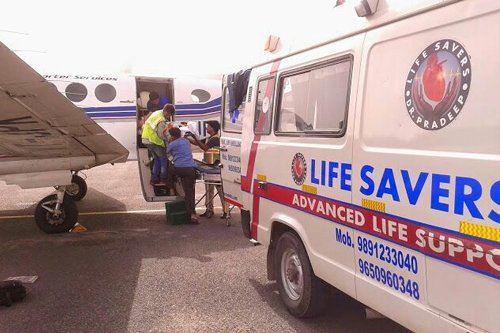
A charter air ambulance is a dedicated aircraft arranged for the patient, an appropriate ICU medical team and the required advanced life-support equipment.
For intercity and international medical flights, a fixed-wing air ambulance may be used when suitable for the route and patient. This is sometimes also described as a private air ambulance or medical charter flight.
A charter air ambulance may be considered when the patient requires:
- Ventilator support.
- Intensive medical monitoring.
- A substantial or continuous oxygen supply.
- Multiple medicines or infusions.
- Restricted movement or specialised positioning.
- Greater privacy than a passenger flight can provide.
- Medical equipment that cannot be used on a commercial flight.
- A schedule that cannot reasonably depend on commercial airline availability.
A charter aircraft can provide greater flexibility, but it does not remove the need for medical assessment. The team must consider the patient’s stability, cabin conditions, flight duration, oxygen consumption, airport access, ground transfer time and receiving hospital arrangements.
ICU Air Ambulance and Critical Care Transport
An ICU air ambulance is planned for patients who require critical care support during an air transfer.
The aircraft, medical team and equipment are selected according to the patient’s condition. Depending on the case, an ICU-equipped medical flight may include:
- Transport ventilator.
- Medical oxygen.
- Multiparameter monitor.
- Defibrillator.
- Suction equipment.
- Infusion pumps.
- Syringe pumps.
- Airway equipment.
- Advanced Cardiac Life Support equipment.
- Emergency medicines.
The term “flying ICU” is commonly used for air ambulances, but the actual capability depends on the equipment, medical team and transfer plan arranged for that patient.
A website equipment list should not be treated as proof that every device will be present on every flight. The required medical setup should be confirmed before the transfer.
Commercial Air Ambulance and Medical Escort Service
A patient does not always need a private aircraft to travel with medical support.
A medically stable patient may be able to use a scheduled passenger flight with a doctor, nurse or other appropriate medical escort. This arrangement may be described as a commercial air ambulance, commercial medical transfer or flight medical escort service.
Depending on the patient’s requirements and airline approval, the arrangement may include:
- Doctor or nurse escort.
- Wheelchair or mobility assistance.
- Airline-approved portable oxygen concentrator.
- Airline-approved medical oxygen where offered.
- Medical monitoring permitted by the airline.
- Suitable seating or additional seats.
- Airline stretcher service where available.
- Airport assistance.
- Ground ambulance coordination.
- Hospital-to-hospital patient transfer.
A portable oxygen concentrator is not suitable for every oxygen-dependent patient. The device, prescribed flow, battery supply and airline approval must meet the patient’s complete journey requirements.
Commercial medical transfer can be more economical than a charter air ambulance, particularly over long domestic or international routes. However, it may not be suitable for an unstable patient or someone requiring intensive intervention, high oxygen flow or equipment that cannot be used safely on a scheduled airline.
Airline Stretcher Service
An airline stretcher service may be considered for a medically stable patient who cannot remain seated during a commercial flight.
On selected airlines and routes, several seats may be combined to accommodate an approved stretcher installation. Privacy curtains and other airline arrangements may also be provided.
The patient generally travels with an appropriate medical escort. Ground ambulances and airport assistance may be coordinated at both ends.
Airline stretcher availability depends on:
- Airline policy.
- Aircraft type.
- Route.
- Seat availability.
- Medical approval.
- Advance notice.
- Equipment and oxygen requirements.
An airline stretcher is different from a charter air ambulance. It uses a scheduled passenger flight and is normally considered only when the patient is stable enough for commercial travel.
Charter Air Ambulance vs Commercial Medical Transfer
| Factor | Charter Air Ambulance | Commercial Medical Transfer |
| Patient suitability | Often considered for critical or medically dependent patients | Generally considered for medically stable patients |
| Aircraft | Dedicated aircraft | Scheduled passenger airline |
| Medical support | Team and equipment planned around the patient | Escort and equipment subject to patient need and airline rules |
| Timing | Greater flexibility, subject to aircraft, crew and airport availability | Depends on flight schedules, seats and medical approval |
| Privacy | Dedicated cabin | Shared passenger cabin |
| Cost | Usually higher | Usually lower when medically suitable |
Neither option is automatically better. The correct choice depends on what the patient requires during the complete journey.
Bed-to-Bed Patient Transfer
A medical flight does not begin at the runway and end after landing.
Bed-to-bed patient transfer means coordinating the patient’s journey from the current hospital, healthcare facility or home to the receiving hospital or final destination.
A hospital-to-hospital air ambulance transfer may involve:
- Reviewing the patient’s condition and medical requirements.
- Preparing the transfer plan.
- Coordinating reports and documents with the current hospital.
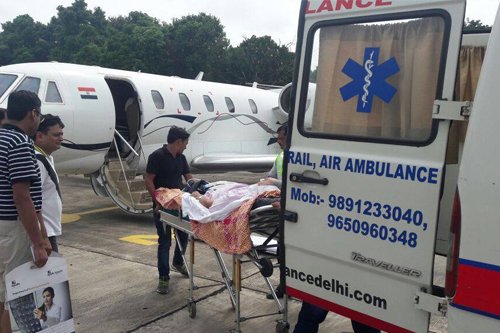
- Picking up the patient in an appropriately equipped ground ambulance.
- Transferring the patient to the departure airport.
- Loading and securing the patient in the aircraft.
- Providing the planned medical support during the flight.
- Moving the patient into a destination ground ambulance.
- Reaching the receiving hospital.
- 10.Completing the clinical handover.
Different professionals may be involved at different stages. Clear communication helps ensure that oxygen, ventilation, medicines, monitoring and medical information continue through each handover.
Life Savers Ambulance Service aims to coordinate these connected stages rather than treating the aircraft as an isolated booking.
Can a Ventilator Patient Travel by Air Ambulance?
Selected ventilator-dependent patients can travel by air ambulance when their condition has been assessed and the necessary team, ventilator, oxygen supply, monitoring and backup arrangements can be provided.
A ventilator air ambulance transfer requires detailed planning. Before confirming the journey, the medical team may review:
- Diagnosis and recent clinical history.
- Present level of stability.
- Airway details.
- Ventilator mode and settings.
- Oxygen requirement.
- Blood pressure and heart rate.
- Current medicines.
- Ongoing infusions.
- Recent investigations.
- Any recent deterioration.
- Expected risks during movement and flight.
Oxygen planning must cover the complete journey, not only the time spent inside the aircraft. It should account for ground ambulances, airport time, loading, unloading and possible delays.
The team must also plan how ventilation, medicines and monitoring will continue while the patient moves between the hospital bed, ambulance stretcher and aircraft.
No ventilated patient should be accepted on the basis of a general promise. Stabilisation, risk assessment and case-specific preparation must come first.
Medical Equipment During Air Transfer
The equipment carried during an aeromedical transfer should be selected according to the patient’s condition.
Respiratory and Oxygen Support
Depending on the patient, this may include:
- Transport ventilator.
- Medical oxygen.
- Airway equipment.
- Suction equipment.
- Backup breathing equipment.
Patient Monitoring
The team may monitor:
- Oxygen saturation.
- Heart rate.
- Blood pressure.
- Cardiac rhythm.
- Breathing rate.
Emergency Support
Depending on the case, emergency support may include:
- Defibrillator.
- Resuscitation equipment.
- Airway devices.
- Emergency medicines.
Medicines and Infusions
Infusion pumps or syringe pumps may be required when medicines or fluids need to continue during transportation.
Specialized Equipment
A newborn baby, child or patient with a particular medical requirement may need additional equipment planned specifically for the transfer.
Equipment availability and configuration should be confirmed for each medical flight.
Medical Team
The accompanying medical team should match the patient’s condition and foreseeable risks.
Depending on the case, the team may include:
- Critical care doctor.
- Emergency physician.
- Anaesthesiologist.
- Critical care nurse.
- Flight nurse.
- Emergency medical technician.
- Paramedic.
- Respiratory care professional.
- Neonatal professional.
- Paediatric professional.
Not every mission requires every type of specialist. A stable patient travelling commercially may need a different medical escort from a ventilated patient undergoing an ICU-to-ICU transfer.
The team should be selected after considering the care required during ground movement, airport handling and flight.
Domestic Air Ambulance Services Across India
Life Savers Ambulance Service coordinates domestic air ambulance transfers between major healthcare centres and other operationally feasible locations across India.
Transfers may be planned to or from cities such as Delhi, Mumbai, Hyderabad, Chennai, Bengaluru, Kolkata, Pune, Ahmedabad, Jaipur, Lucknow, Patna, Bhubaneswar, Guwahati, Nagpur, Kochi, Visakhapatnam and Chandigarh.
Domestic air ambulance planning involves more than calculating the flight distance.
The complete journey may be affected by:
- Distance between the hospital and airport.
- City traffic.
- Location of the available aircraft.
- Aircraft positioning time.
- Airport operating hours.
- Runway and aircraft suitability.
- Ground ambulance access.
- Loading and unloading time.
- Weather and operational restrictions.
- Receiving hospital readiness.
A short flight does not always produce a short bed-to-bed transfer. For some routes, an ICU road ambulance, rail ambulance or combined transport plan may be more practical.
Route-specific searches such as “air ambulance from Patna to Delhi” or “air ambulance from Guwahati to Delhi” require individual assessment because aircraft availability, route distance and patient requirements can change the plan and cost.
International Air Ambulance Services
International air ambulance services may be used to move a patient from India to another country, bring a patient back to India or transfer someone between two international destinations.
Depending on the patient and route, the international medical transport plan may include:
- International charter air ambulance.
- Fixed-wing medical flight.
- Commercial medical escort.
- Airline stretcher service.
- Business-class or other suitable seating.
- Ground ambulances in both countries.
- Airport and hospital coordination.
- Bed-to-bed international patient transfer.
International air ambulance arrangements require medical, aviation and cross-border coordination. The proposed schedule should only be confirmed after the required information and approvals have been reviewed.
Medical Evacuation and Medical Repatriation
Medical evacuation and medical repatriation are related but not identical services.
A medical evacuation, sometimes called a medevac, generally involves moving a patient to a location where suitable treatment can be accessed.
Medical repatriation usually means helping a patient return to their home country or travel closer to their family and usual healthcare system.
A medical evacuation or repatriation plan may require:
- Recent medical reports.
- Fitness-to-fly assessment.
- Airline medical clearance.
- Passport and visa review.
- Receiving hospital acceptance.
- Airport handling.
- Route and flight permissions.
- Ground ambulances at both ends.
- Communication between hospitals.
- Medical escort or critical care team.
International transfers may take longer to arrange than domestic journeys because different airline, immigration, airport and operational requirements may apply.
Neonatal and Paediatric Air Ambulance
Newborn babies and children require transport planning suited to their age, weight and medical condition.
Depending on the case, a neonatal or paediatric air ambulance transfer may require:
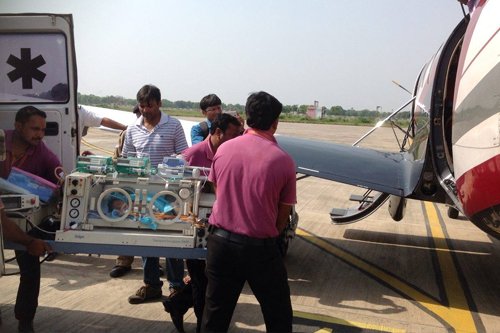
- Transport incubator.
- Neonatal ventilator.
- Paediatric ventilator.
- Medical oxygen.
- Age-appropriate monitoring.
- Infusion or syringe pumps.
- Emergency medicines.
- A suitably trained neonatal or paediatric medical professional.
The team should review the child’s current treatment, oxygen or ventilator needs, recent reports and receiving hospital arrangements before confirming the transfer.
Not every child requires a dedicated charter aircraft. The transport method should be selected after assessing the child’s stability and the level of support required.
Other Medical Transport Options
An air ambulance is not automatically required for every long-distance patient transfer.
ICU Road Ambulance
An ICU road ambulance may be appropriate for shorter routes or patients who can tolerate road travel with the required monitoring, oxygen or ventilator support.
Rail Ambulance
A rail ambulance may be considered for selected stable patients when the route, journey time, railway arrangements and medical requirements make it practical.
Commercial Medical Escort
A stable patient may travel with a medical escort on a scheduled flight when the airline approves the required medical arrangements.
Multimodal Patient Transfer
Some journeys require more than one type of transport. Ground ambulances may be combined with a charter flight, scheduled commercial flight or rail journey to create a complete bed-to-bed plan.
The transport decision should consider:
- Patient condition.
- Distance.
- Urgency.
- Total journey time.
- Required medical support.
- Route.
- Operational feasibility.
Air Ambulance Cost in India
There is no single air ambulance price that applies to every patient or route.
An air ambulance quote is prepared after reviewing where the patient is, where they need to go and what medical care will be required throughout the journey.
Air ambulance charges may be affected by:
- Origin and destination.
- Flight distance and route.
- Aircraft type.
- Aircraft location and positioning.
- Aircraft and crew availability.
- Airport charges and handling.
- Patient’s medical condition.
- Oxygen requirement.
- Ventilator requirement.
- Medical team composition.
- Specialist support.
- Additional medical equipment.
- Ground ambulances at both ends.
- Commercial airline tickets.
- Airline stretcher arrangements.
- Domestic or international documentation.
- Operational permissions and international clearances.
A commercial flight with a medical escort has a very different cost structure from a private air ambulance carrying a ventilated ICU patient.
Families looking for an affordable air ambulance should compare what each estimate includes. A lower quotation may exclude ground ambulances, airport handling, medical equipment or other necessary parts of the transfer.
The lowest price is not automatically the best value. Two air ambulance quotes can only be compared properly when they include the same medical team, equipment, ground transfers and operational arrangements.
How to Book Air Ambulance Services in India
To book air ambulance services in India, begin by sharing accurate medical and journey information. These details help the coordination team assess whether the patient requires a charter air ambulance, ICU air ambulance, commercial medical transfer or another medically supervised transport option.
Step 1: Share the Patient’s Location and Destination
Provide the current hospital or pickup point, destination city and receiving hospital, if already selected.
Step 2: Share the Medical Information
Useful initial details include:
- Diagnosis.
- Present medical condition.
- Level of consciousness and stability.
- Oxygen requirement.
- Ventilator settings where applicable.
- Monitoring requirements.
- Medicines and infusions.
- Recent medical summary.
- Treating doctor’s details where available.
- Preferred timing and urgency.
Step 3: Medical Assessment
The medical information is reviewed to understand whether the patient is suitable for transfer and what support may be required.
Additional reports or clarification from the treating hospital may be requested.
Step 4: Select the Appropriate Transport
The possible options may include:
- Charter air ambulance.
- ICU air ambulance.
- Commercial medical transfer.
- Airline stretcher service.
- Medical escort.
- ICU road ambulance.
- Rail ambulance.
- Combined bed-to-bed transfer.
Step 5: Receive the Transfer Plan and Air Ambulance Quote
The proposed route, medical team, equipment, ground ambulances, expected schedule and case-specific estimate are explained before confirmation.
Step 6: Confirm the Air Ambulance Booking
After confirmation, the required medical, aviation, airline, airport, ambulance and hospital arrangements are coordinated.
Complete and accurate information helps the family book air ambulance services without avoidable changes or delays later in the planning process.
Book Air Ambulance Services
To book air ambulance services, keep these details ready:
- Patient’s current location.
- Diagnosis and present medical condition.
- Current hospital or pickup point.
- Destination city or hospital.
- Oxygen, ventilator or monitoring requirements.
- Recent medical reports.
- Treating doctor’s details where available.
- Preferred timing and urgency.
The Life Savers Ambulance Service medical coordination team can review the case and help identify an appropriate transport option.
Share complete patient and journey information so that the proposed air ambulance service, medical team and estimate reflect the patient’s actual requirements.

Dr. Pradeep Gupta
Critical Care And Transportation Specialist
Current Handling Critical Care Ambulance services around the world, Founder And Chief Mentor at Life Savers, Start up in Train Ambulance on Ease of availability and Financial savvy.
Past Worked as Intensivist In Sir Ganga Ram Hospital(Delhi) for Many Years
Qualification MBBS, Diploma in Critical Care
Frequently Asked Questions